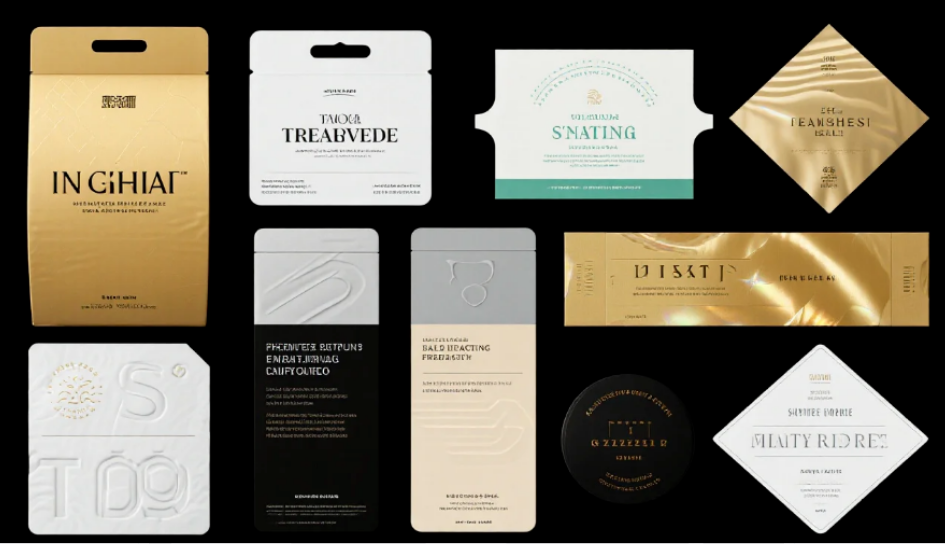
Plain four-color loses on shelf. The label that gets picked up is doing two or three things at once — foil catching light, spot UV pulling focus, emboss giving your thumb something to feel.
That is a multi-process self-adhesive labels for premium packaging build: two or more print + finishing passes on one pressure-sensitive construction. One piece, three jobs — information, shelf pop, and authentication.
Read this in 5 minutes if you: run beauty, liquor, food or 3C packaging — and need to pick foil, UV and emboss without overpaying or guessing.
What can one label actually do?
Think in three layers, not just looks:
- Sell. Foil + texture + contrast stops the hand. Half a second longer on shelf is often enough to win.
- Work. Fluorescent ink or microtext for anti-fake. Overlaminate + the right adhesive for water, heat, or cold chain. Visible copy up front, hidden trace code underneath.
- Feel. Matte film, flock, raised foil-emboss. Touch is what makes a $30 cream feel like $80 before the jar opens.
Where does multi-process label pay off fastest?
- Beauty: gilt relief on glass, thermochromic ink on sunscreen that shifts with heat.
- Food & drink: foil seals for spirits, low-temp PET + laminate for olive oil and frozen SKUs.
- Electronics & medical: scuff-proof laser labels for 3C, sterilization-resistant stocks for ISO 11607 workflows.
- Luxury: etched-metal logos for leather, microtext foil for jewelry.
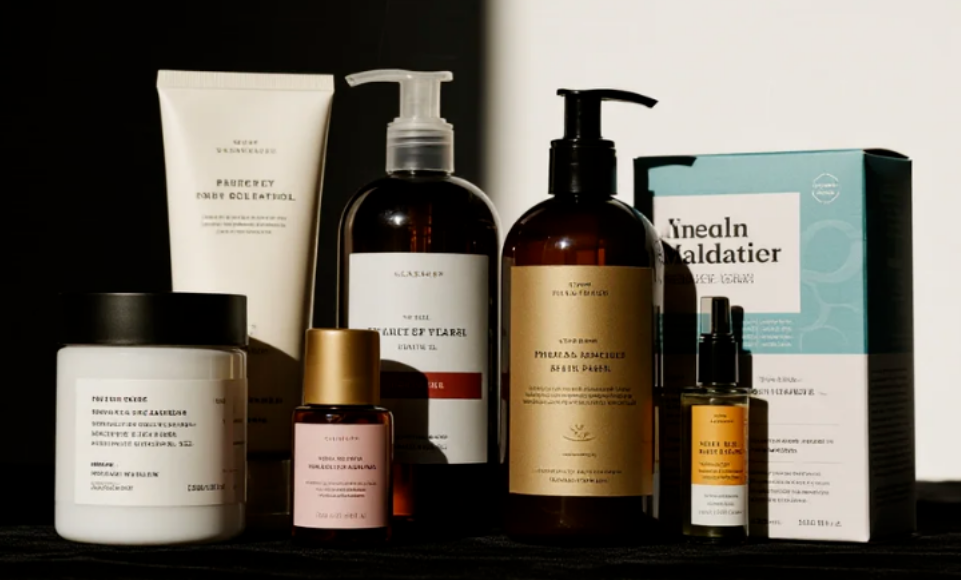
Our repeat data is consistent: a three-process upgrade typically supports 20–30% higher retail. Tooling pays for itself in one season.
How do I pick the right combo process?
Three steps. Environment first, priority second, run length last.
Step 1: Lock the environment
Get this wrong and nothing else matters. Match face + adhesive to where the label lives:
| Where it lives | What to spec | What to avoid |
|---|---|---|
| Wet / bathroom, bottled drinks | PET or PP + overlaminate + water-resistant inks | Uncoated paper |
| Hot / kitchen, thermos | Heat-proof PP + hot-melt past 120°C + UV topcoat | Low-temp adhesive |
| Cold chain / frozen | Low-temp PET + winter adhesive to -30°C | Laminate that wrinkles in chill |
| High rub / tools, 3C | Hard UV coat 3H+ on 50-micron-plus stock | Unprotected metallic ink |
| Outdoor sun | UV-stable inks + PETG face | Bare metal effects |
Step 2: Pick one priority
- Want pop? Laser foil + gradient ink + spot UV. For FMCG and toys.
- Want quiet luxury? Matte laminate + silver foil. Or clear film + reverse UV for a no-label look.
- Want function? Security ink + chemical-resistant adhesive + overt/covert coding. For medical and food.
- Want cheap + decent? Digital + one finish. Spot UV on matte laminate goes a long way.
Step 3: Match run length
- Under 10k: digital, no plates. Local foil or UV only.
- 10k–50k: flexo + two stations (print + foil + die-cut).
- Over 50k: rotary offset + full stack. Tooling amortizes fast.
- Rush under 7 days: skip flock and deep emboss. Digital + spot UV only.
How long will multi-process label last?
- Indoors: 3–5 years. No drama.
- Outdoors, weatherable build: 2–3 years.
- Replace when: adhesive yellows, edges curl, or color washes out. Don’t wait.
Benchmarks we test to: ink anchorage to GB/T 7706, laminate at 3H pencil hardness, adhesive stable -20°C to 60°C.
Will more processes cost a lot more?
Yes, but not linearly. Expect 15–25% over a basic print-laminate build at the same size. Each extra station adds processing plus 5–10% more waste from multi-pass handling.
Volume fixes it. Under 10k, plates don’t amortize — uplift can top 30%. Past 50k, unit cost can drop 30% versus the 10k price.
And context matters. A $0.014 laser uplift that lifts sell-through 15% is cheap. A $0.10 flock + foil uplift that supports a $10 retail bump is even cheaper. The expensive label is the one that falls off and triggers a recall.
Which combos look premium without trying too hard?
| Combo | Feel | Use it for |
|---|---|---|
| Matte laminate + silver foil | Quiet, low-saturation metal | Skincare, specialty coffee |
| Emboss + spot UV | Touch vs. gloss | Liquor, gift boxes |
| Clear film + reverse UV | Floating, no-label look | High-end 3C, medical |
| Laser foil + gradient | Moving light | Holiday runs, designer toys |
| Flock + raised foil | Suede touch, crisp logo | Jewelry, couture |
What is it made of? How is it run?
Three parts. Face: art/kraft, PET/PVC/PP, or specials like metalized film. Deco layer: security inks, hard UV oil, hot/cold foil. Adhesive: general emulsion, hot-melt for heat, high-tack acrylic for rough surfaces.
On press, in order: prepress → base color (±0.1% dot) → foil at 120–150°C / UV at 5–10 microns, cured at 365nm / emboss 0.1–0.3mm → laminate → rotary die-cut → vision check → moisture-proof pack.
We lock the route before plates are cut — e.g. print → foil → emboss → die-cut. Curved bottles get a pre-curl test first.
How do you keep quality steady?
- Incoming: caliper ±3%, peel ≥1.5N/25mm, 80°C/24h with no distortion.
- On press: sensors on foil temp (±2°C drift stops the web), signed first article.
- Finished: to GB/T 18354 — 500 rubs no loss, -20°C/48h no crack, 3M tape pull clean.
Ship in 5-ply corrugated. Store flat, under 1.5m stack, 18–25°C / 40–60% RH, away from light and solvents. Unopened: 12 months paper, 24 months film. Applied: 1–2 years outdoors, 3–5 indoors dry.
Bottom line
A good combination label is a silent salesman. It stops the hand, proves it’s real, and survives the fridge and the truck.
Get a free process consult → Send container photos, conditions, and quantity. We’ll spec stock + foil + finish and ship a real-stock sample to scratch, chill, and peel.