☎ +86 13392540241 ✉ sale@labellet.com 🕒 26 yrs label experience  ·  ISO 9001 CERTIFIED

HIGH TEMPERATURE LABELS · L1–L6

High Temperature Labels to 350°C — L1–L6

Six grades from one factory. Send peak and dwell time, we place the grade.

350 °C continuous coverageL1–L6 six gradesC/4/660 barcode after ageing5-day standard proofing

SUBSTRATE, ADHESIVE AND INK AGE DIFFERENTLY

Labellet — Professional Industrial High Temperature Label Manufacturer in China

Stick a label on hot metal and the face-stock, the glue and the ink age at different speeds. One of them always gives up first, and then the whole mark is scrap. That is why we qualify substrate, adhesive and ink as three separate parts. Here is the shop behind that claim.

Stocked Substrates, Shorter Lead Times

Six face-stocks sit on our shelves (heat-stabilised coated paper, PET synthetics, polyimide (PI / Kapton), polyolefin (PP), aluminum foil / metallised film and fluoropolymer (PTFE / PFA)), stocked alongside 20+ adhesives. Standard builds proof in 3-5 days and ship in 7-15; specials such as extra-thick PI or ultra-high-temperature silicone proof in 7 and ship in 18.

Three Layers Tested Separately

Most high temperature labels fail at the glue line or in the ink, not in the face-stock. We therefore qualify each layer on its own: DSC / TGA on the substrate for Tg and decomposition, peel-vs-temperature curves on the adhesive, and post-bake colour plus adhesion re-checks on the ink. Failures never reach the press.

Printers & Die-Cutters Made for Thick PI and Foil

9-colour, 10-colour and 12+2 full-rotary presses handle hot webs; screen, thermal-transfer, laser, inkjet and flexo imaging stay on option. Six high-speed die-cutters hold ±0.2 mm on thick PI and foil, while foiling, holographic and UV units run inline for one-pass finishing.

L1–L6 GRADES AT A GLANCE

Match the Heat-Resistant Grade to Your Real Peak Temperature

Continuous duty plus short peak, with the face-stock and home application for each. Overspecifying wastes money; underspecifying wastes the batch.

GradePositionContinuous TempShort peak tempFirst-choice faceTypical home
L1Normal60–80 °C100 °C / 30 minHeat-stabilised coated paperKitchen appliances, HVAC nameplates
L2Mid-range100–120 °C150 °C / 30 minPET synthetic / coated paperBoards, PACK outers, device inners
L3Hot service150–200 °C220 °C / 30 minPET / PP synthetic filmHarnesses, lamps, oven parts
L4Ultra-high200–500 °C300 °C / 5 minPolyimide (Kapton)Reflow PCB, reels, engine bays
L5Extreme260–350 °C400 °C / 5 minFoil / metal / ceramicKiln trays, exhausts, hot ends
L6Chemical-inert200 °C+ in acids & alkalis260 °C / 30 minPTFE / PFA fluoropolymerVessels, cleanrooms, chambers

From 80°C to 350°C

Pick Your Solution by Peak Temperature: PET, PP, PI & Foil

Each solution lists strengths with stated limits (applications, precautions and label specifications) so your choice passes your service-temperature audit.

L1 · Low Cost, High VolumeHeat Resistant Coated Paper Labels for Appliances & HVAC

TL;DR — 60–80 °C continuous · cheapest way to pass a 100 °C audit

A thermoset resin and heat-stable pigment coating is laid over commodity label paper, holding dimensional stability through 80–120 °C. On a standard acrylic it runs continuous duty at 60–80 °C. If your peak stays under 100 °C, this is the cheapest way to pass the audit. PI or foil would just cost more for nothing.

  • Kitchen appliance nameplates, sanitary-ware marks, HVAC equipment, lamp rating plates.
  • 70–100 g stabilised coated paper, acrylic good to 100 °C. Our QC sign-off line: ≥80% peel after 100 °C / 100 h, ΔE ≤ 3.0.

L2–L3 · Mid-Range PET for ElectronicsPET Synthetic Marks for Electronics, Batteries & Ovens to 200°C

TL;DR — 150–200 °C stable · needs corona + primer, or edges whiten

Biaxially stretched PET replaces wood-pulp paper, so the web stops absorbing moisture and stops drifting with it. Stable from roughly 150 to 200 °C, with a bright matte-white face that keeps barcode contrast high.

  • Control boards, battery PACK outer marks, harness tags, oven and microwave parts.
  • One warning from our line: untreated PET shrinks slightly past 150 °C and die-cut edges can whiten in damp heat, so we run corona plus a primer coat first.
  • Our usual build is 50–60 μm matte-white PET or 60–90 μm synthetic paper on silicone or high-temperature acrylic. It holds ≥85% peel after 180 °C / 100 h, still C/4/660 after 150 °C ageing.

L3 · PP for Water and AcidsPP Tags for Chemical Drums & Outdoor Gear in Hot Service

TL;DR — 120–200 °C, water + acid proof · glue softens near 150 °C

PP is the budget pick when water and chemistry matter more than peak heat. Light, cheap, and at home on drums and outdoor gear from 120 to 200 °C. Hot-melt bonds it straight to PP / PE carriers, well below polyimide cost. That makes it our waterproof and heat resistant label option for drums and outdoor gear.

  • Chemical drums, tote boxes, outdoor enclosures. Holds ≥80% peel after 150 °C / 100 h, no swell in 5% NaOH or 5% HAc.
  • Its ceiling is the glue: hot-melt softens near 150 °C, so anything running 180 °C all day moves to PET or PI.

L4 · PI for Reflow and Engine BaysHigh Temperature Polyimide (PI / Kapton) Labels for PCB Reflow

TL;DR — 300 °C continuous · glue decides everything, laser-marked

PI survives because of the imide ring in its backbone: 500 °C all day, 300 °C short peaks. The failure point is never the film, it is the glue. Commodity acrylic dies past 200 °C, so we only ship PI on its own high-temperature silicone, laser-marked first so the image is carbonised into the film instead of sitting in ink.

  • PCB top-side marks through SMT, reel / tube / tray component tags, engine bays, battery modules, hot-end aerospace parts.

L5 · Foil for Kilns and ExhaustsFoil & Metal-Base Plates for Kilns, Exhausts and Hot Ends

TL;DR — 260–350 °C, flat metal only · cracks if bent under 5 mm

Foil at 660 °C melt point simply outlasts every polymer past 300 °C, and it blocks oxygen and moisture outright. We bond it with a metal-grade adhesive, or skip adhesive and go weld / rivet for the hottest trays. The trade-off is stiffness: bend it tighter than 5 mm and the web cracks, cut edges can burr. Flat metal only.

  • Kiln trays and setters, exhaust pipes, cylinder blocks, steel housings in hot zones. 30–80 μm foil, no distortion after 350 °C / 5 h, helium leak-tight to 0.5 Pa·m³/s.

Need coated paper for L1 or PTFE / PFA for L6 chemical duty? Both run on the same lines. Ask for the L1 / L6 sheet.

EVERY MATERIAL, ONE TABLE, SIDE BY SIDE

High Temperature Label Materials Compared: PET, PP, PI & Foil

All six builds (L1 to L6) compared on heat range, adhesive hold, print and compliance.

ItemCoated paperPET syntheticPI polyimidePP polyolefinFoil / metal basePTFE / PFA
GradeL1 · 60–80 °CL2–L3 · 100–200 °CL4 · 200–500 °CL3 · 120–200 °CL5 · 260–350 °CL6 · 200 °C+ in acids & alkalis
Short peak100 °C / 30 min220 °C / 30 min500 °C / 5 min200 °C / 30 min400 °C / 5 min260 °C / 30 min
Face thickness70–100 g paper50–60 μm PET / 60–90 μm synthetic25–50 μm PI60–80 μm PP30–80 μm foil / metallised PET50–150 μm PTFE / PFA
AdhesiveHeat acrylicHigh-temp acrylic / siliconePI-grade / high-temp siliconeHot-melt / synthetic rubberMetal-gradeFluoro / weld fixing
Hold at 150 °C / 1 kg≥ 2 h≥ 8 h≥ 24 h≥ 4 h≥ 24 h≥ 8 h
PrintFlexo / digital / thermal-transferFlexo / digital / thermal-transferThermal-transfer / laser / screenFlexo / digitalLaser engraving / black inkLaser / black mark
Post-age barcodeC/4 after 120 °CC/4 after 200 °CC/4 after 500 °CC/4 after 180 °CC/4 after 300 °CC/4 after 200 °C
Die-cutting±0.2 mm±0.2 mm±0.2 mm±0.2 mm±0.3 mm, watch burrs±0.2 mm
FlameUL 94 V-2UL 94 V-0UL 94 V-0UL 94 V-2Non-combustibleUL 94 V-0
Relative costLowMidMid-highLow-midHighVery high
MOQ / lead1000 pcs · 5 / 15 days1000 pcs · 5 / 15 days1000 pcs · 7 / 18 days1000 pcs · 7 / 18 days1,000 pcs · 10 / 25 days500 pcs · 12 / 30 days

BUILT AROUND YOUR CYCLE

Custom Heat Resistant Labels in 8 Decisions

For custom high temperature resistant labels, answer these with your engineer and the quotation lands in one round, with no back-and-forth on missing peaks and dwell times.

A · Pick the construction — steps 1–4

01 · Temperature class

L1 through L6, with short peaks from 100 °C / 30 min up to 400 °C / 5 min. Tell us dwell time and peak; we place the grade, no back-and-forth.

02 · Face-stock

70–100 g coated paper, 50–60 μm PET, 25–50 μm PI, 60–80 μm PP, 30–80 μm foil or metallised film, 50–150 μm PTFE / PFA (Tg and Td5 bands on the data sheet).

03 · Adhesive

Heat acrylic, high-temperature acrylic, high-temperature silicone, PI-grade, metal-grade, fluoropolymer systems, plus alkali-resistant rubber for chemical duty. Holding power quoted at 150 °C / 1 kg, 2 h through 24 h.

04 · Print & marking

Flexo, digital, thermal-transfer, screen, laser marking, laser engraving. Inks top out near 120 / 150 / 200 °C; past L4 we default to laser because the colour then comes from the material itself.

B · Prove it survives & finish it — steps 5–8

05 · Finish inline

Overlaminate, foil stamping, holographic, UV, all on our own lines and formed in the same pass as the label.

06 · Barcode that survives

We re-verify aged heat resistant barcode label samples to ISO/IEC 15416 / 15415 and report the aged grade: 120, 180, 200, 260 or 300 °C ageing, each with its own C/4/660 verdict.

07 · Bend & mount

Flat, limited bend (radius > 5 mm), wrap or mechanical fixing. Foil and fluoropolymer crack on folds, so we lock the mounting method at quoting stage.

08 · Flame & safety

UL 94 V-2 or V-0 on polymer builds; foil and metal-base builds are non-combustible by nature.

LAB-VERIFIED PERFORMANCE DATA

How Our High-Temperature Labels Perform

Every construction below is verified after heat ageing, with peel, barcode grade, colour and registration re-checked against the raw-material data sheet. Showing the 10 heat-critical lines first; expand for the full 34-line lab sheet.

Top 10 heat-critical results first · full 34-line sheet on expand
PropertyTest Standard / MethodLabellet Typical ValueIndustry Reference
Short-term heat resistance (distortion)Visual inspection after 10-min hot pressNo distortion at 260°CNo distortion at 180°C
Short-term heat resistance, PI film300°C / 10 min exposureNo distortion, no yellowingRated to 250°C
Continuous operating temperature150°C / 1,000 h ageingPeel retention ≥ 85%≥ 70%
Long-term heat ageing, PI film260°C / 500 hNo embrittlement, no edge lift200°C / 500 h
Thermal shock (heat–cool cycling)−40°C ↔ 260°C, 100 cyclesNo cracking, no adhesive failure−40°C ↔ 180°C / 50 cycles
Peel adhesion after heat ageing150°C / 100 h → 180° peelRetention ≥ 85% (typical batch 87–92%)≥ 70%
Barcode verification after heat ageing (1D + 2D)150°C / 100 h → re-verified to ISO/IEC 15416 / 15415C/4/660 on both (1 of 20 QR samples dropped to C/3 on first run, passed on reprint)C/3/660
Dimensional stability after heat ageing150°C / 100 h≤ 0.5%≤ 1.5%
Print-to-die registration shift after heat ageing150°C / 100 h, checked at 20×≤ ±0.2 mm≤ ±0.3 mm
Colour difference ΔE after heat ageing150°C / 100 h, spectrodensitometerΔE ≤ 3.0ΔE ≤ 5.0
Yellowing after heat ageing, PI film260°C / 100 h, Lab colourΔL* ≤ 2.0 (edges run ~0.5 higher than centre)ΔL* ≤ 4.0
Decomposition temperature Td5TGA, 5% weight lossPET ≥ 350°C / PI ≥ 500°CPI ≥ 450°C
Glass transition temperature TgDSCPI ≥ 360°C / PET ≥ 70°C—
Heat deflection temperature (HDT)0.25 MPa loadPI ≥ 300°C / PET ≥ 150°C—
Ink adhesion after heat ageing150°C / 100 h → 3M 810 tape, cross-hatchGrade ≥ 4Grade ≥ 3
Thermal stability of heat-resistant ink (print density)150°C / 4 h → optical-density re-checkDensity shift ≤ 10%≤ 20%
Initial tack of heat-resistant adhesive (30 min after application)Rolling-ball tack (FINAT FTM 2 equivalent)≥ 8 N/m≥ 5 N/m
Shear holding power at 80°C / 1 kgStatic shear≥ 24 h≥ 12 h
Shear holding power at 150°C / 1 kgStatic shear≥ 8 h≥ 4 h
Release force (silicone release liner)180° peel15–30 N/m (drifts up ~10% after 6-month storage; re-check before die-cutting)20–40 N/m
Die-cutting registration (heavy-gauge PI / aluminum foil)Checked at 20×≤ ±0.2 mm≤ ±0.3 mm
Flex endurance (engine-bay harness duty)180° bend × 500 cycles at 150°CNo cracking200 cycles
Abrasion resistance (handling)500 g / 50 cycles @ 150°CLegends and codes stay legible (2 of 50 samples showed faint edge whitening)20 cycles
Damp-heat resistance85°C / 85% RH / 168 hPeel retention ≥ 80% (1 of 12 samples showed 0.3 mm edge lift)65°C / 96 h
Steam-ageing resistance121°C steam / 30 minNo distortion, no edge lift (matte overlaminate recommended for 3+ cycles)100°C / 15 min
Hot oil-mist resistance120°C oil mist / 100 hNo ink bleed, no loss of tack (wipe test: 100 cycles clean)100°C / 24 h
Chemical resistance (strong acids & alkalis)5% NaOH / 5% HAc on 200°C surfaceNo swelling, no loss of adhesionAmbient-temperature rating only
Flame retardancyUL 94V-0V-1
UV-ageing resistanceXenon-arc, 200 hPeel retention ≥ 85%, ΔE ≤ 3.0100 h
Dielectric strength (PI film)1 kV AC, 1 min≥ 5 kV/mm≥ 3 kV/mm
Partial-discharge (corona) resistance, PI filmAC 5 kV partial-discharge testNo breakdown—
Surface resistivityAfter 100°C ageing108–1012 Ω/sq—
Biocompatibility (optional)ISO 10993-5 cytotoxicityNo cytotoxic responseReport available on request
Sterilisation tolerance (optional)121°C moist-heat sterilisation × 3 cyclesLegends and codes stay sharp and scannable1 cycle

How to read this table: Td5 = film starts to decompose · Tg = film softens · HDT = film deflects under load · ΔE = colour shift · TGA / DSC = lab thermal methods.

Need the full lab report behind a line item? Email sale@labellet.com with your peak, dwell time and substrate. We reply within 24 hours.

WHY LABELLET FOR HEAT

Why 1000+ Clients Trust Us

Six grades and five solutions under one roof, plus the verification habits that keep hot labels working.

Full in-house chain, traceable to the operator

Raw material, prepress and platemaking through printing, foiling / holographic / die-cutting and finishing, then laser / inkjet / thermal-transfer coding, barcode verifier validation, QC inspection, packing and dispatch: every step runs on our own lines, with every operator on record and every batch traceable.

Laser-first past L4

Above 260 °C the mark should come from carbonised material instead of ink chemistry. Variable data such as furnace lots, serials and sequences gets the marking method its zone allows, stated on the proposal.

Stocked webs, fixed dates

Six face-stocks and 20+ adhesive variants sit ready, so L1–L3 holds 5 / 15-day delivery. Foil and fluoropolymer quote their real 25–30-day window up front.

Combined-duty testing

Heat-plus-humidity, heat-plus-oil, heat-plus-steam, heat-plus-flex and heat-plus-abrasion are run together with a written combined report, because single-factor passes rarely match the shop floor.

Request Free Sample

Free swatch pack · replies in 24h

No spam. Prefer email? Write to sale@labellet.com

Success stories

Proven in Production, Documented for QA.

3 high temperature label builds (SMT reflow, engine bay and kiln tray), each shipped with re-test and verifier reports.

SMT Reflow PCB Labels — PI + Laser Marking

SMT Reflow PCB Labels — PI + Laser Marking

Industrial control & automotive boards · EMS plant

Customer
Electronics contract manufacturer in China (industrial-control and automotive-electronics boards).
Product Requirements
PI heat-resistant labels on PCB, carrying logo, reference designators and furnace-trace QR codes.
Material Structure
25 μm dull-gold PI + PI-grade adhesive + laser marking (carbonised image, not dependent on ink heat resistance).
Compliance
IPC/JEDEC J-STD-033 · ISO/IEC 15415 C/4/660.

What we finally produced:

  • Flat and bonded after three 260 °C reflow passes, no edge lift.
  • QR still C/4/660 after reflow; laser image means no ribbon to stock.

Final Delivery: Mounted proof + post 3×-reflow re-test report + barcode verifier report.

Engine-Bay Part ID — High-Temperature PI

Engine-Bay Part ID — High-Temperature PI

Cylinder blocks & turbo housings · Tier 1 supplier

Customer
Automotive Tier 1 parts supplier in China.
Product Requirements
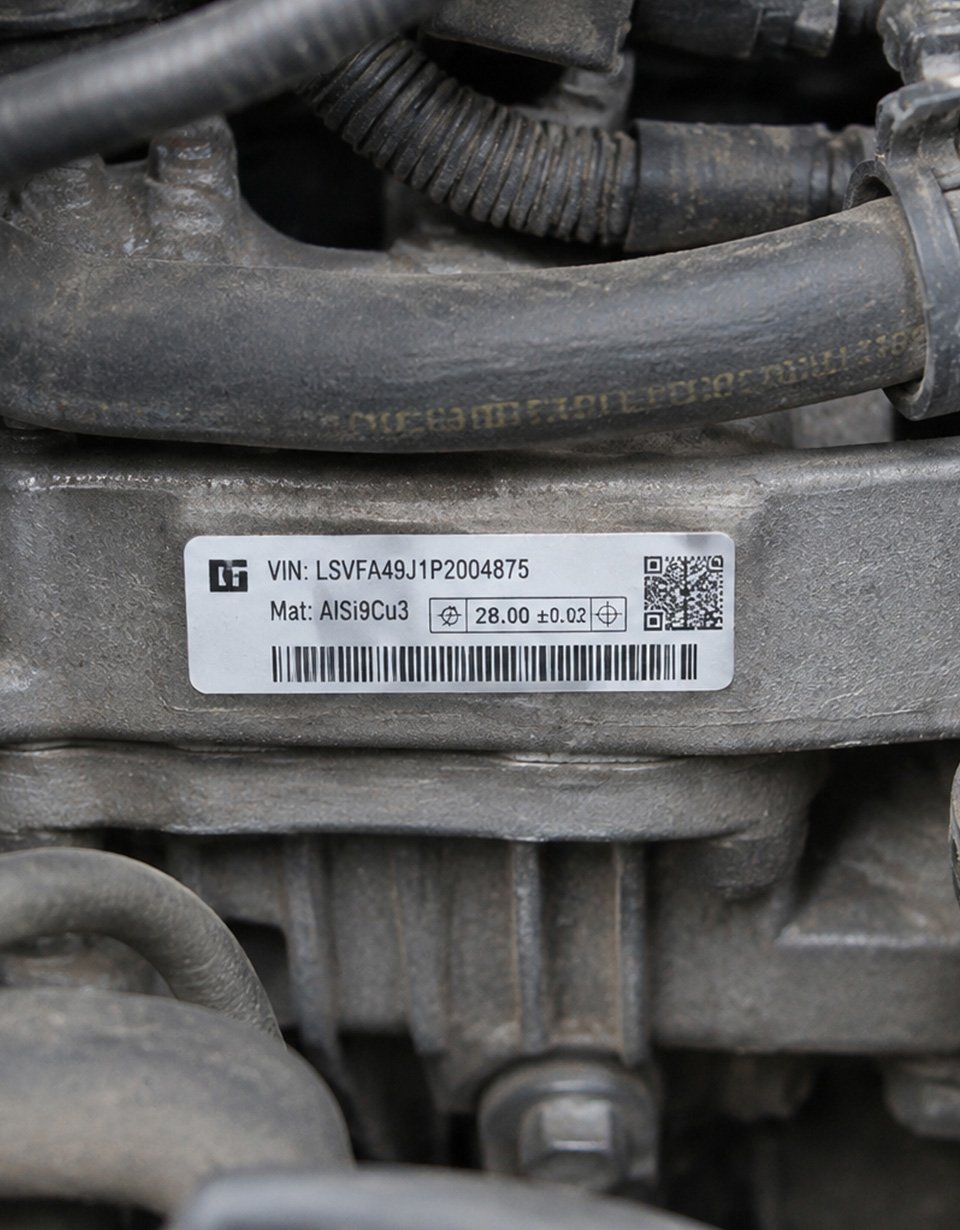
PI ID labels on engine blocks and turbocharger housings, with VIN-linked codes, material grades and tolerance marks.
Material Structure
50 μm matte-white PI + high-temperature silicone + laser marking + clear protective film.
Compliance
OEM second-party audit under IATF 16949 · AIM DPM 2006 C/4/660.

What we finally produced:

  • Zero cracking over 100 shocks from −40 °C to 500 °C.
  • Peel still ≥ 85% after 1,000 h at 150 °C; no bleed after 100 oil / coolant wipes.
  • Cleared the 8-year equivalent service validation for the engine bay.

Final Delivery: Mounted proof + thermal-shock and 1,000 h ageing report + verifier re-test.

Kiln Tray Batch Traceability — Foil + Laser Engraving

Kiln Tray Batch Traceability — Foil + Laser Engraving

Precision ceramics / glass sintering · 350 °C duty

Customer
Precision-ceramics / glass sintering plant in China.
Product Requirements
350 °C-rated foil-base tray ID carrying furnace number, batch code and loading-position code.
Material Structure
60 μm aluminum foil + high-temperature metal-base adhesive (spot-weld fixing optional) + black heat ink or laser engraving.
Compliance
Customer kiln-process specification (400 °C short peak max.) · in-house traceability system.

What we finally produced:

  • No distortion after 350 °C / 5 h; legends intact after 2,000 tray turns.
  • First trial curled at the weld edge. Fixed by switching to 60 μm foil with a wider weld margin.
  • Helium leak-tight to 0.5 Pa·m³/s, no permanent set after brief 800 °C exposure.

Final Delivery: Furnace-trace layout + post-exposure distortion report + turnaround abrasion log.

BEFORE YOU QUOTE

FAQ

Straight answers for buyers and product managers.

1Will heat resistant barcode labels still scan after the heat cycle?

If the construction fits your cycle, yes. We print with heat-rated ribbons or laser, then age the sample and re-grade it to ISO/IEC 15416 / 15415. What ships carries a written aged grade (for example C/4/660 after 260 °C), not just "print looks fine".

2How do I pick between PET, PP, PI and foil?

Peak temperature and dwell time first, then chemistry and mounting. As a rule of thumb: PET for most 150–200 °C electronics, PP where water and acids matter, PI for reflow and engine bays to 500 °C, foil past 300 °C. Send the profile and we place the grade.

3Can I use one label for steam, oil and heat at once?

Sometimes. Dry-heat passes mean little on a washdown line, so we re-run the build under heat-plus-humidity, heat-plus-oil-mist or heat-plus-steam and report the combined result.

4What artwork do you need for a heat-rated quote?

Vector files with outlined fonts, 3 mm bleed and a cut layer are ideal (AI, PDF or CDR). For variable data, send the code list or numbering rule.

5What is the MOQ and lead time?

Standard grades start at 1000 pcs: 5-day proofs, 15-day production. PI builds run 7 / 18 days; foil and fluoropolymer run longer (typically 10–12 days to proof and 25–30 to ship) because the material and adhesive are made to order.

6Do you keep my part numbers and drawings confidential?

Yes. Your artwork and serial ranges never go into catalogues or other customers\u2019 samples, and we can sign an NDA before you send files.

Still deciding between PET and PI? Email sale@labellet.com with peak, dwell and substrate. We reply within 24 hours.

Send Your Heat Profile. Get Your Build Spec in 24h.

Peak, dwell time, substrate and quantity. We return grade, construction, proof date and price.

Request Free Sample
Email
WhatsApp
WhatsApp QR code
WeChat
WeChat QR code
Labellet Manufacturer
Privacy Overview

This website uses cookies so that we can provide you with the best user experience possible. Cookie information is stored in your browser and performs functions such as recognising you when you return to our website and helping our team to understand which sections of the website you find most interesting and useful.